

Bread That Heals

If you’ve never baked your own bread, you might be surprised by how simple—and deeply satisfying—it really is. Few things awaken all your senses the way bread does. The feel of the dough as you knead it, the quiet magic of watching it rise, the punch‑down that releases its warmth, the smell that fills your kitchen as it bakes, the first slice while it’s still steaming, the melt of real butter, and the chorus of your family’s oohhs and aahhhs. Nothing else compares.
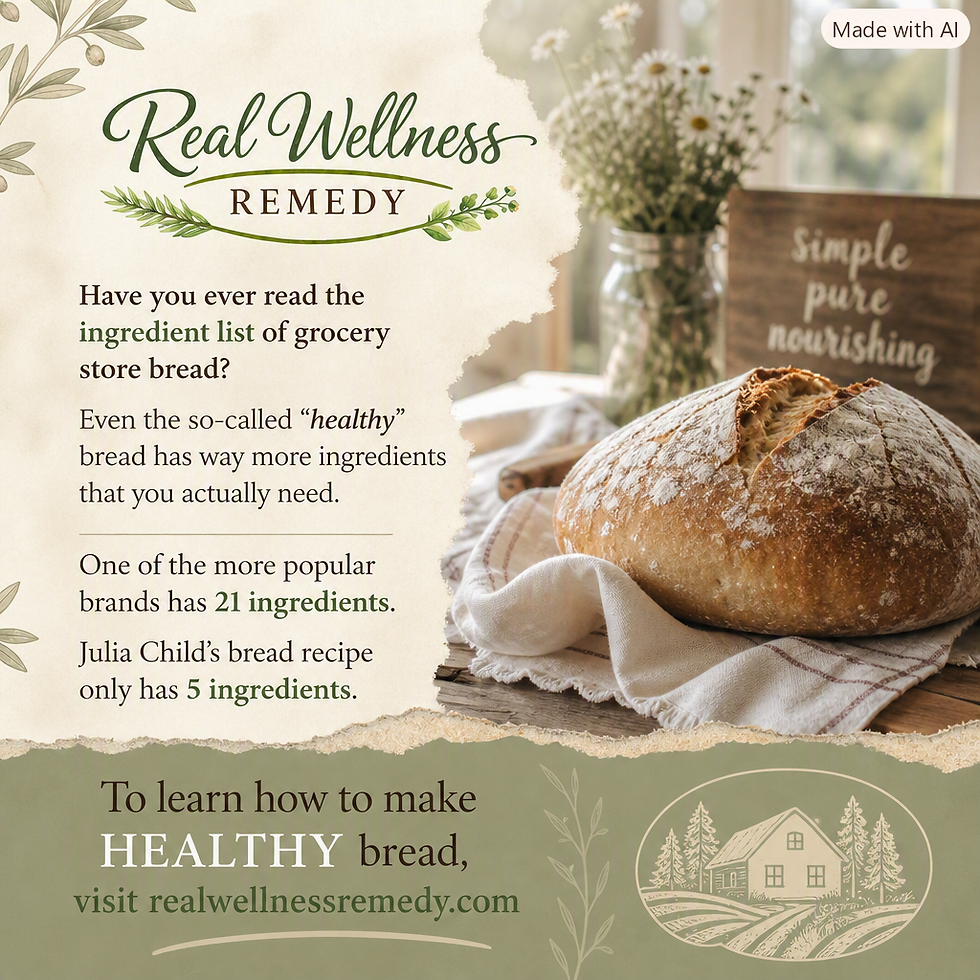
Have you ever read the ingredient list of grocery store bread? Even the so-called "healthy" bread has way more ingredients that you actually need. One of the more popular brands has 21 ingredients. Julia Child's bread recipe only has 5 ingredients.

Let's look at some of these ingredients.
Enriched wheat flour - This is enriched because the wheat berry has been stripped of most of its beneficial parts, the endosperm, the bran, and the germ. Synthetic vitamins are added back to make it seem healthy.
These are the parts of the wheat that give bread its health benefits.
Endosperm - contains soluble fiber, carbohydrate, protein, iron, and B vitamins
Bran - contains protein, B vitamins, trace minerals, and dietary fiber (mostly insoluble)
Germ - contains protein, trace minerals, and more B vitamins than the other parts
One of the greatest gifts of the B‑vitamin complex is the essential role it plays in metabolism. When these vitamins come naturally from whole, unprocessed ingredients, the body recognizes and uses them efficiently. If bread still contained its original B vitamins—rather than having synthetic versions added back after processing—it wouldn’t work against our waistline. In fact, real, nutrient‑intact bread would actually support metabolic health instead of burdening it.
Wheat gluten — yes, gluten is naturally part of wheat, but the gluten that ends up in most store‑bought bread is a very different thing. During commercial processing, wheat is broken down so aggressively that manufacturers often add isolated, highly processed gluten back into the dough. They do this to give the dough enough elasticity and strength to survive industrial mixers and high‑speed production lines.
Homemade bread doesn’t need this. When you work with real flour and a gentle mixing process, the dough develops its own natural structure without any added gluten.
About Celiac disease, roughly 1 in 100 people are affected, and an estimated gluten sensitivity may impact around 13% of the population—approximately 18 million people. For those individuals, the ultra‑processed gluten found in commercial bread can be especially problematic.
Calcium sulfate - an odorless, white powder. There are 2 forms of this that are often added to bread made commercially.
Anhydrous calcium sulfate, which is also used to make cement and is a filler used in the production of paper.
Dihydrate calcium sulfate, which is also used to make Plaster of Paris.
Monocalcium phosphate - a leavening agent that is known to increase the risk of cardiovascular disease and kidney disease.
Soy Lecithin - comes from soy and may affect people with soy allergies. While this product has some health benefits, hexane, which is a neurotoxin, is required to extract the lecithin from the soybean.
Is it any wonder that our society is sick, fat, and malnourished?
Whole grain, with its bran and germ intact, naturally contains phytic acid. Phytic acid is considered an antinutrient because it can bind to minerals and reduce their absorption, and it can make bread harder for the body to digest.
Interestingly, it also acts as an antioxidant, helping reduce oxidative stress in cells. So it’s not inherently “bad”—it’s just reactive.
When flour is soaked overnight, the phytic acid is largely broken down. This simple traditional step deactivates its mineral‑binding effects and transforms it into a beneficial compound. The result is bread that’s gentler on digestion and richer in bioavailable nutrients.
Avoid bleached white flour with your life… literally. Once the bran and germ are stripped away, the flour is left with almost no meaningful nutrition. Whole grain flour—preferably organic—still contains the bran and germ, and soaking helps unlock the nutrients inside them. Soaking is what transforms whole grain from “hard to digest” into a genuinely nourishing ingredient.
Soaking works best when the flour is mixed with an acidic liquid. Sour milk, buttermilk, or kefir are ideal, but water combined with lemon juice, yogurt, whey, or vinegar also works. These acidic liquids activate phytase, the enzyme that breaks down phytic acid and makes minerals more available to the body.
Sour milk products add lactic acid, which helps break down starches, tannins, and tough-to-digest proteins. This not only improves digestion but also increases the bioavailability of nutrients.
When making bread, simply use the milk or water already called for in your recipe as your soaking liquid. If you’re using water, add one tablespoon of apple cider vinegar per cup. Mix the flour, the liquid, and the acid (if needed), then leave the mixture on the counter in a warm, draft-free spot for 12 to 24 hours. After soaking, finish the recipe as usual.
You can also soak 2 cups of flour with 2 cups of yogurt (with no processed ingredients) to make muffins, pancakes, and other baked goods. Soaking makes everything better.
An alternative is sprouted flour. Because the grain has already gone through germination, the phytic acid is naturally broken down, and the nutrients are more accessible—just like soaked flour.
Whole Wheat Bread
3 cups of whole wheat flour (organic is best!)
1 1/8 cups of warm water plus 2 tablespoons of apple cider vinegar for soaking
1/4 cup of water for activating the dry yeast
2 tablespoons of honey or maple syrup
2 tablespoons of olive oil or melted butter
2 teaspoons of active dry yeast
1 1/2 teaspoons of kosher salt (or 3/4 teaspoon of regular salt)
Add all 3 cups of whole wheat flour to a bowl. Add 1 1/8 cups of warm water, 2 tablespoons of apple cider vinegar or lemon juice to the flour. Combine, cover, and place bowl on the counter for 12 to 24 hours.
When you are ready to make your bread, add 1/4 cup of warm water, honey or maple syrup, and dry yeast to a bowl. Stir until the yeast is dissolved and allow it to stand for 5 minutes until it's foamy.
Add olive oil or melted butter to the yeast mixture and stir.
Combine salt into the soaked flour.
Gradually add the dry mixture to the wet mixture. Stir with a wooden spoon until a dough forms.
Transfer dough to a lightly floured surface and knead for 8-10 minutes or until the dough becomes elastic. If you have a stand mixture with a dough hook, it may not take as long. I don't have one, so use your best judgement.
When the dough is ready, shape it into a ball and place it in a greased bowl. Cover the bowl with a clean kitchen towel and allow the dough to rise in a warm place for 1 1/2 hours or until it has doubled in size.
Once the dough has risen, punch it down (yes, literally!) to release the air. Place the dough on a lightly floured surface and shape it into a loaf. Place the loaf in a loaf pan, cover it with a kitchen towel, and allow it to rise again for 30-45 minutes or until it rises above the edge of the pan.
Preheat the oven to 375°. Bake for 35-40 minutes until it turns golden brown on top. When you remove it from the oven, allow it to cool in the pan for a few minutes. Then transfer the bread to a cooling rack.
Slice your bread and enjoy it with REAL butter. You will never look at grocery store bread the same again.
Resources
Wheat Foods Council. (2019, July 19). A kernel of wheat - Wheat Foods Council. https://www.wheatfoods.org/resources/wheat-facts/kernel-of-wheat/
Anatomy of a wheat kernel – Flour.com. (n.d.). https://flour.com/anatomy-of-a-wheat-kernel/
CDC - NIOSH Pocket Guide to Chemical Hazards - Calcium sulfate. (n.d.). https://www.cdc.gov/niosh/npg/npgd0095.html
Calcium sulfate | Encyclopedia.com. (n.d.). https://www.encyclopedia.com/science/academic-and-educational-journals/calcium-sulfate
EWG - Environmental Working Group. (n.d.). How do we know what we are eating, really? Find out with @EWG Food Scores! #FoodAnswered @EWG Food Scores! #FoodAnswered. EWG - Environmental Working Group © 2025. https://www.ewg.org/foodscores/ingredients/7349-CalciumPhosphateMonoDiandTriBasic/
Hanna, M., Jaqua, E., Nguyen, V., & Clay, J. (2022). B vitamins: Functions and uses in Medicine. The Permanente Journal, 26(2), 89–97. https://doi.org/10.7812/tpp/21.204
The Weston A. Price Foundation. (2016, August 18). Home - the Weston A. Price Foundation. The Weston a. Price Foundation. https://www.westonaprice.org/#gsc.tab=0
Shannon. (2025, March 18). How to Convert any Baked Good Recipe to a “Soaked” Recipe. Plan to Eat. https://www.plantoeat.com/blog/2013/03/how-to-convert-any-baked-good-recipe-to-a-soaked-recipe/
LaBonte, A. (2024, April 12). whole wheat bread. Girl Versus Dough. https://www.girlversusdough.com/whole-wheat-bread/#wprm-recipe-container-39063
Tasha. (n.d.). Soaking flour: the why’s and how’s. https://lifeonpurposemama.blogspot.com/2011/01/soaking-flour-whys-and-hows.html


Comments